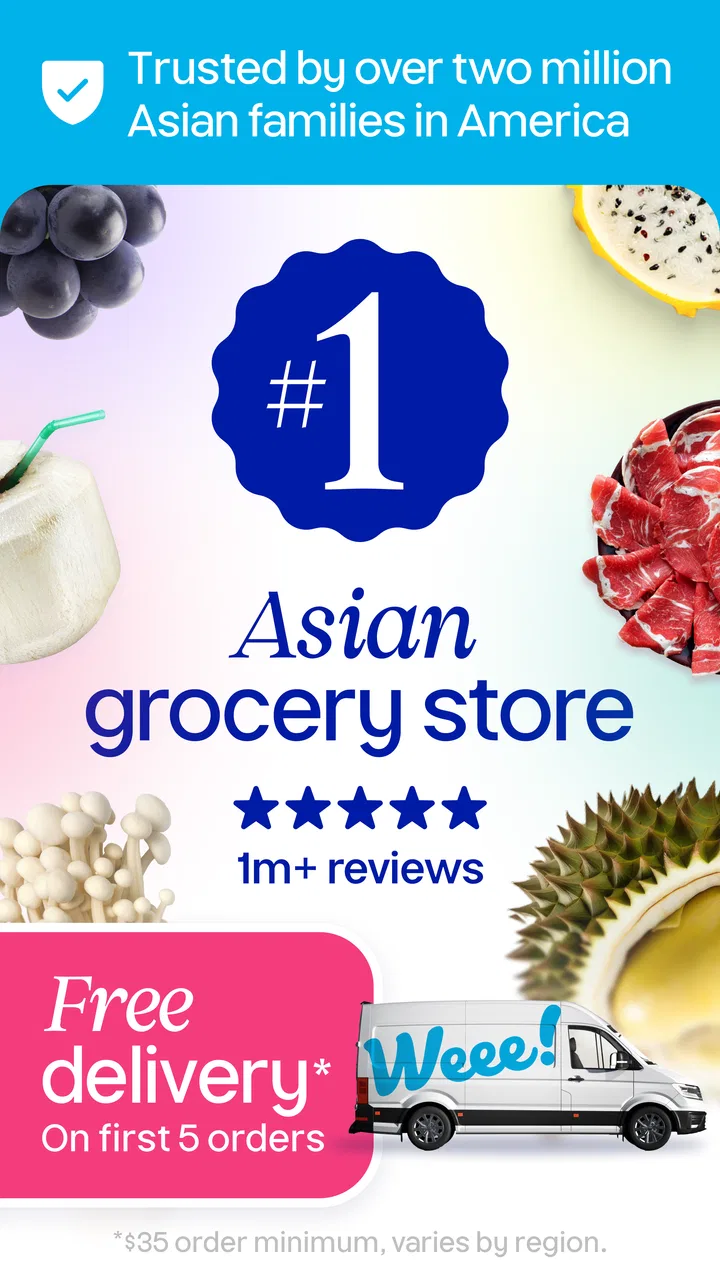
Weee! Asian Grocery Delivery
- 4.9
- Rating
- 1.00M
- Installs
- Free
- Price

 Analysis by App-foxy
I noticed the appeal of Weee! Asian Grocery Delivery almost immediately: it turns a shopping trip that can require several specialty stores into a single browsing session. As a Food & Drink app from Weee! Inc., it is built around online grocery shopping rather than recipes, restaurant ordering, or meal planning. That distinction matters. I would recommend it to someone who regularly buys Asian ingredients, snacks, drinks, frozen foods, or household staples and wants a more convenient way to look for them.
The first impression is helped by the fact that the app is free and available to everyone. It has a 4.9 average from around 19K ratings, and its reach is clear from more than 1M installs. Those figures suggest that it is not a novelty used by only a small group of curious shoppers. In my experience, the more important question is whether it remains useful after the first exciting browse. Grocery apps can feel impressive when the selection is new, then become frustrating if searching, delivery planning, or repeat ordering takes too much effort.
From an exciting first browse to a practical grocery habit
I look at Weee! through the small decisions that make grocery shopping workable: whether I can scan product details comfortably, narrow a search without losing my place, and make an order in the time and setting I have. Those details matter as much as the range of ingredients, particularly when shopping on a phone is not effortless. From there, I consider how well the experience holds up across different abilities and everyday circumstances.
You May Also Like

 Blood Strike: 2.5 Anniversary
Blood Strike’s Loadouts Turn Every Drop Into a Tactical Gamble
A close look at Blood Strike’s custom loadouts: how fast access to signature weapons reshapes its battle royale rhythm, rewards preparation, and narrows the gap between fights.

 Pandora - Music & Podcasts
Pandora’s Music Is Easy to Start, but Harder to Recover
Pandora’s strength is its low-effort path from a seed to a station. Its weak spot is how much confidence it asks you to place in connection, setup, and quiet recovery.

 8 Ball Pool
 Is Built on Rivalries, Rematches, and Routine
A close look at the rivalries, rematches, shared routines, and unanswered safety questions that turn a quick pool match into a persistent mobile community.

 Samsung Music
’s Quiet Strength Is Playing What You Already Own
Its reach comes less from spectacle than from dependable access to a personal library. That simplicity is both the app’s strongest retention engine and its ceiling.

 AccuWeather: Weather Radar
AccuWeather Review: A Quick, Clear Forecast for Everyday Decisions
For everyday plans, the best forecast is the one you can understand quickly. AccuWeather makes rain timing, radar, and local conditions easy to act on, with a few trade-offs.

 Hill Climb Racing
Why Hill Climb Racing Still Turns Crashes Into One More Run
A tiny car, a bumpy hill and one more upgrade: Hill Climb Racing keeps resurfacing because its simple chaos makes every near-miss feel personal.
More From Our News Desk



The first-week appeal comes from discovery
My first week with Weee! felt less like opening a normal supermarket app and more like walking through several aisles that are difficult to find in one place. The attraction is not simply that groceries can be ordered online. It is the combination of familiar pantry items and products that are often scattered across local markets, international sections, and specialty shops.
That makes the app especially useful when I know the kind of ingredient I want but do not know which nearby store carries it. Instead of driving around to compare availability, I can start by searching for the item and then browse related products. This is a better experience for planned shopping than for a rushed, five-minute purchase, because the catalog encourages me to build a fuller basket.
I also found the discovery side surprisingly relevant to households with different food traditions. A person may be shopping for noodles, sauces, rice, frozen foods, tea, snacks, or cooking ingredients in the same session. The app’s identity is much clearer than that of a general grocery service: it is aimed at people who want Asian groceries to be central to the order rather than treated as a small section at the edge of a conventional supermarket.
That focus is its strongest early advantage over ordinary grocery apps. A mainstream service may be more convenient for milk, cleaning supplies, or a quick local staple, but it can make specialty products harder to find. Weee! is more compelling when the shopping list has several culturally specific items on it. If my basket contains only everyday supermarket basics, the reason to use it becomes much weaker.
A realistic first order needs a little planning
A useful way to approach the first order is to treat it as a pantry restock rather than an emergency shop. I would make a list before opening the app, search for the items one by one, and then look at nearby alternatives before checking out. This reduces the temptation to fill the basket with interesting snacks while forgetting the ingredients that motivated the order.
That workflow also helps with substitutions. When I am buying a sauce or noodle variety, I want to compare sizes, flavors, and styles instead of selecting the first result. The extra browsing is valuable when I am familiar with the cuisine, but it can feel like work when I only need one specific product. Someone who dislikes comparing unfamiliar grocery items may prefer a local store where the shelf and packaging provide immediate context.
For a household preparing a weekend meal, the app makes more sense than it does for a single last-minute ingredient. I can gather the pantry items in one session, add snacks or drinks for the rest of the week, and avoid turning the meal plan into several separate errands. That is the kind of use case that gave the app lasting potential for me: it solves a recurring logistics problem, not just a moment of curiosity.
What the app is and what it is not
It is worth setting expectations early. This is a grocery shopping app, not a cooking teacher. It may help me find ingredients, but it does not replace knowing what I plan to cook or understanding the differences between similar products. If I search broadly, I still need to read product names and descriptions carefully and decide what fits my recipe.
That can be a benefit for experienced shoppers because the app does not force a simplified interpretation of the cuisine. It can be a drawback for beginners who expect the service to explain how every ingredient is used. I would use it alongside a recipe source, a family shopping list, or notes from a previous meal rather than expecting the catalog itself to guide the whole cooking process.
The second month is where the real test begins
After the novelty fades, the value depends on whether Weee! helps me repeat successful purchases without making me start from zero. Grocery shopping is repetitive by nature. I do not want to rediscover the same rice, tea, dumplings, or pantry ingredients every time. The app earns a regular place on my phone only when browsing can turn into a predictable routine.
My preferred monthly pattern would be to keep a running list of items that are nearly finished, then place one considered order instead of opening the app whenever I remember something. This approach makes the service more useful because specialty shopping often works better as a planned basket. It also limits impulse buying, which is one of the main ways an enjoyable food catalog can become expensive or cluttered.
Weee! is strongest for people who already have a repeatable shopping rhythm. If someone cooks Asian dishes several times a month, buys the same snacks for family members, or needs ingredients that local supermarkets rarely carry, the app has a clear recurring role. The value is not just access to individual products; it is the time saved by combining a particular kind of shopping into one destination.
For occasional shoppers, the calculation is different. If I only need one specialty ingredient every few months, a nearby international market may be faster and more satisfying. I can inspect the packaging, compare alternatives on the shelf, and leave with the item immediately. The app becomes more attractive when the order contains enough relevant groceries to justify planning around it.
How it compares with the usual alternatives
Compared with a general supermarket app, Weee! feels more focused and more useful for culturally specific shopping. A mainstream service usually wins when I need a broad household order, especially if I am already buying fresh basics and want everything handled together. Weee! wins when the important part of the basket is Asian groceries and the local options are inconvenient or incomplete.
Compared with visiting a specialty market, the app trades physical certainty for convenience. In a store, I can examine packaging, judge freshness directly, ask an employee a question, and change my mind at the shelf. Online, I gain a calmer search process and avoid travel, but I must pay closer attention to what I select and plan around the order rather than taking the food home immediately.
Compared with restaurant delivery, the app is aimed at a completely different habit. Restaurant apps solve tonight’s meal; Weee! supports the ingredients and snacks that shape several meals. I would not open it when I want dinner in the next half hour. I would open it when I want to make my kitchen better prepared for the coming days.
Maintenance is manageable, but it is still maintenance
The main burden is not learning the app. It is maintaining a sensible grocery routine. I need to remember what is already in the pantry, avoid duplicating products, and leave enough time for an order to fit my plans. Online grocery shopping can make the catalog feel infinite, while my cupboard remains finite.
My practical tip is to separate “needed soon” from “interesting.” The first group belongs in the planned basket. The second group can wait until I know there is room, a recipe for it, or a genuine reason to try it. This small distinction protects the app from becoming a source of food waste and protects my budget from being driven by attractive browsing.
I would also keep a note of products that worked well, including the exact variety or package description. That is particularly useful when several similar sauces, noodles, teas, or snacks appear in search results. A personal shortlist makes future orders faster and reduces the chance of buying something merely because its name looks familiar.
The current version is 26.2.1, and the app supports devices running Android 6.0 or later. That broad compatibility makes it approachable for people who do not use a recent phone. Still, compatibility alone does not remove the everyday friction of shopping on a small screen. Comparing several similar products can take patience, especially when I am trying to shop quickly.
Where fatigue starts to appear
The first source of fatigue is browsing without a clear list. Food discovery is enjoyable at the beginning, but the same strength can slow me down when I want a precise item. A large, specialized catalog invites comparison, and comparison is useful only until it starts delaying the actual order.
The second is the gap between online confidence and real-world cooking needs. Product names can be familiar while the exact variety is not. I may recognize a brand but still need to check whether the item suits a recipe, a dietary preference, or the tastes of everyone at home. The app can make the product easier to find, but it cannot make every choice effortless.
The third is relying on one service for every grocery need. I would not replace a general supermarket app or local market entirely with Weee!. A mixed strategy is more practical: use Weee! for the specialty products that give it an advantage, and use the local store or a broader grocery service for ordinary items and immediate needs.
There is also a psychological fatigue that affects many food apps: the difference between collecting possibilities and actually using what arrives. If I order too many unfamiliar snacks or ingredients, the catalog has encouraged consumption rather than solved a shopping problem. The app works best when I use discovery to support meals and household routines, not when browsing becomes the routine itself.
Who will keep using it after the novelty fades?
I think the strongest long-term users are people who already have a meaningful connection to Asian food, whether through family cooking, regular meal preparation, cultural familiarity, or simple enthusiasm for ingredients that are difficult to find locally. They will notice the convenience repeatedly because the same shopping challenge returns each month.
It is also a good fit for busy households that prefer one planned specialty-grocery order over several trips. Parents, shared households, and home cooks can benefit when different people want different snacks or when a recipe requires several less-common ingredients. The app is particularly sensible when travel time is the main obstacle rather than price comparison.
I would tell a beginner to try it, but with a small, purposeful basket. Start with products whose names and uses are already clear, then expand after learning what the household actually enjoys. That avoids turning the first order into an expensive experiment and gives the app a fair chance to become useful.
I would tell someone to skip it if they mainly need instant access to ordinary groceries, prefer choosing produce in person, or rarely cook with Asian ingredients. In those cases, a local supermarket or general grocery service is likely to be simpler. The app’s specialization is an advantage only when that specialization matches the shopping list.
Privacy, cost, and practical expectations
Because the app is free to install and carries an Everyone content rating, there is little barrier to trying it. The more meaningful cost is the time and discipline involved in online grocery planning. I would judge each order by the convenience it creates, not by the excitement of the catalog alone.
I would also avoid assuming that an online listing automatically makes every purchase better than a store visit. A local market may offer immediate availability and a chance to inspect products. Weee! is valuable when it reduces the effort of finding specialty groceries, but the best choice still depends on urgency, the size of the basket, and how comfortable I am selecting food without standing in front of it.
Its strong user response, including around 2.3K written reviews alongside the ratings, gives me confidence that the basic concept resonates with many shoppers. I still see that as a reason to test the workflow personally rather than a promise that every order will suit every household. Grocery habits are unusually personal, and convenience depends on what I cook and how often I shop.
My long-term verdict
Weee! earns lasting space on my phone when I use it as a focused specialty-grocery tool. Its best quality is not the excitement of finding an unusual snack during the first browse. It is the ability to make a recurring category of shopping more organized, especially when local stores require extra travel or do not carry the products I want.
The app does demand a little maintenance: I need a list, a repeatable ordering rhythm, and enough attention to distinguish similar products. It is less suitable for emergency meals, tiny baskets, or people who want to inspect every item in person. Those are real limitations, not minor details.
Even so, I would recommend trying it if Asian groceries are a regular part of your kitchen. Start with a planned order, save the products that genuinely work, and let the app prove its value through repetition. The lasting benefit is controlled convenience, not endless browsing. When used that way, Weee! feels like a practical companion for monthly pantry planning rather than another app that loses its purpose after the first week.
Developed by Weee! Inc., it has been available since October 4, 2016, and its current version keeps the service accessible across a wide range of Android devices. For me, that history matters less than the everyday result: when specialty groceries are a recurring need, this free Food & Drink app can replace several frustrating searches with one more deliberate shopping routine.
FAQs for Weee! Asian Grocery Delivery
01What is Weee! Asian Grocery Delivery, and how does it work?
Weee! is a convenient app that specializes in delivering Asian groceries right to your doorstep. It offers a wide range of products, including fresh produce, snacks, and pantry staples. Users can browse the app, add items to their cart, and schedule delivery. The app provides a seamless shopping experience with secure payment options.
02Is Weee! available in my area?
Weee! is continually expanding its delivery areas, primarily focusing on major metropolitan regions across the United States. To check availability, you can enter your zip code on the app or website. If your area isn’t currently covered, you can sign up for notifications when it becomes available.
03What types of products can I find on Weee!?
Weee! offers a diverse selection of Asian grocery items, including fresh fruits and vegetables, meats, seafood, snacks, beverages, and specialty items from various Asian cuisines. The app frequently updates its inventory to include seasonal products and popular new items, ensuring a comprehensive shopping experience.
04How does Weee! ensure the quality and freshness of its products?
Weee! partners with trusted suppliers and local farmers to source high-quality products. They implement strict quality control measures and maintain a cold chain supply process to ensure freshness. Additionally, they offer a satisfaction guarantee, allowing customers to report any issues with their orders for resolution.
05Are there any membership fees or delivery charges with Weee!?
Weee! does not require a membership fee. Delivery charges may vary based on location and order size, but the app frequently offers promotions and discounts. Orders over a certain amount may qualify for free delivery. Check the app for the latest updates on delivery fees and promotions.
Pros
- Wide variety of Asian groceries.
- User-friendly interface.
- Fast delivery options.
- Regular discounts and promotions.
- Easy payment methods.
Cons
- Limited delivery areas.
- Occasional out-of-stock items.
- No option for in-store pickup.
- App requires constant updates.
- Limited customer service hours.

Weee! Asian Grocery Delivery
Gallery